

GMP-Compliant Powder Handling: Key Design Considerations for Food and Pharma Plants
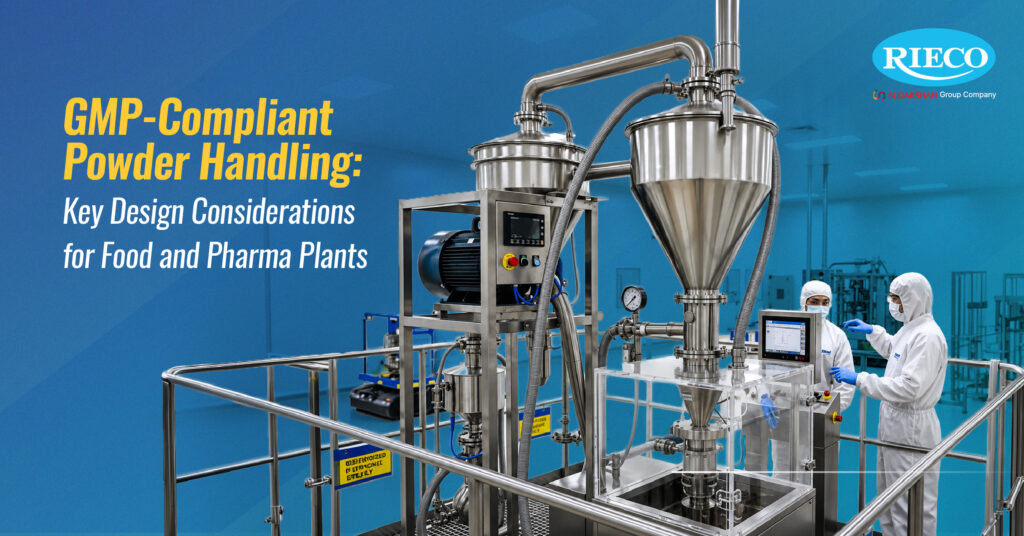
Pharma Industry
Product quality in the food and pharmaceutical industries is not solely determined by formulation. The way materials are handled throughout the process has an equal impact. In particular, powders are extremely sensitive to environmental exposure, contamination, and segregation.
At this point, handling powder in accordance with GMP regulations becomes extremely critical. It assures that materials move through the system without compromising hygiene, traceability, or consistency. For manufacturers operating under strict regulatory frameworks, powder handling is not just an operational concern. It is a compliance requirement.
What Does GMP-Compliant Powder Handling Mean?
Good Manufacturing Practices focus on maintaining product integrity throughout production. In the context of powders, this translates to systems that prevent contamination, minimise human contact, and maintain controlled environments. A powder-handling system designed for GMP compliance must address:
- Cleanability and sanitation
- Controlled material transfer
- Prevention of cross-contamination
- Consistent and traceable material flow
These principles apply across both food and pharma powder handling, where safety and quality standards are non-negotiable.
Why Powder Handling Needs Special Attention
Powders behave differently from solid or liquid materials. They can become airborne, absorb moisture, or segregate during movement. In pharmaceutical applications, even minor contamination can affect drug safety. In food processing, it can impact flavour, shelf life, and regulatory acceptance. Without proper design, systems may lead to:
- Dust generation and product loss
- Cross-contamination between batches
- Inconsistent mixing or dosing
- Hygiene risks due to residue build-up
This makes contamination-free powder handling a core requirement rather than an added feature.
Key Design Considerations for GMP Compliance
Hygienic Equipment Design
Surfaces that come in contact with powders must be smooth, non-reactive, and easy to clean. Stainless steel construction is commonly used to meet hygiene standards. Crevices, sharp edges, and dead zones should be avoided, as they can trap material and lead to contamination.
Closed System Handling
Open handling increases the risk of contamination from the environment. GMP-compliant systems use enclosed transfer methods to protect the material. This is particularly important in pharma powder handling, where exposure must be strictly controlled.
Controlled Material Flow
Uniform flow is essential for maintaining batch consistency. Irregular flow can lead to segregation or uneven processing. A well-designed powder handling system ensures steady movement from storage to processing without interruptions.
Dust Control and Air Management
Airborne particles pose both safety and contamination risks. Effective dust control systems are necessary to capture particles at the source. This supports hygienic powder handling by maintaining clean working environments and preventing product loss.
Ease of Cleaning and Maintenance
Frequent cleaning is a requirement in GMP environments. Equipment must be designed for quick disassembly and thorough cleaning. In some cases, Clean-in-Place (CIP) systems are used to reduce downtime and maintain hygiene standards.
Material Segregation Prevention
During handling, powders with different particle sizes may separate. This affects product uniformity. Proper system design, including controlled flow paths and minimal drop heights, helps maintain consistency.
Differences Between Food and Pharma Powder Handling
While both industries follow GMP principles, their priorities differ slightly.
- Food powder handling: The focus is often on preventing contamination and maintaining sensory properties such as taste and colour.
- Pharma powder handling: The emphasis is on precise dosing, traceability, and strict contamination control due to regulatory requirements.
Despite these differences, both require systems designed for contamination-free powder handling.
Role of Automation in GMP Compliance
Automation reduces human intervention, which is one of the primary sources of contamination.
Automated feeding, conveying, and dosing systems improve consistency and traceability. They also support compliance by maintaining controlled operating conditions.
In modern plants, automation is not just about efficacy. It is a key enabler of GMP standards.
Importance of Material Behaviour in System Design
Even the most hygienic system can fail if material behaviour is not considered. Factors such as flowability, moisture sensitivity, and bulk density influence how powders move through the system. Ignoring these can lead to blockages or inconsistent flow. Understanding these properties ensures that the powder handling system performs reliably under real conditions.
How Rieco Industries Limited Aligns with GMP-Compliant Handling
In industries where hygiene and precision are imperative, system design must go beyond basic functionality.
Rieco’s engineering approach focuses on creating solutions that support hygienic powder handling while maintaining process efficiency. By integrating controlled material transfer, dust management, and solid system design, their solutions match the requirements of both food and pharmaceutical applications.
Solutions such as the Rieco Pneumatic Conveying System enable enclosed and controlled material transfer, supporting contamination-free powder handling across different stages of production.
Common Mistakes to Avoid
Even with GMP guidelines in place, certain design oversights can lead to compliance issues. These include:
- Open transfer points exposing material to contamination
- Poor cleaning access leading to residue build-up
- Inadequate dust control systems
- Ignoring material flow behaviour
Addressing these at the design stage prevents costly modifications later.
Conclusion
GMP-compliant powder handling is a major aspect of modern food and pharmaceutical manufacturing. It confirms that product quality, safety, and regulatory standards are maintained throughout the process. By keeping an eye on hygienic design, controlled handling, and material behaviour, manufacturers can build systems that deliver consistent and contamination-free output.
As regulatory expectations continue to evolve, investing in well-designed powder handling systems is a must for compliance and operational stability in the future.


