

How ESP Systems Help Cement Plants Control Clinker Dust Emissions?
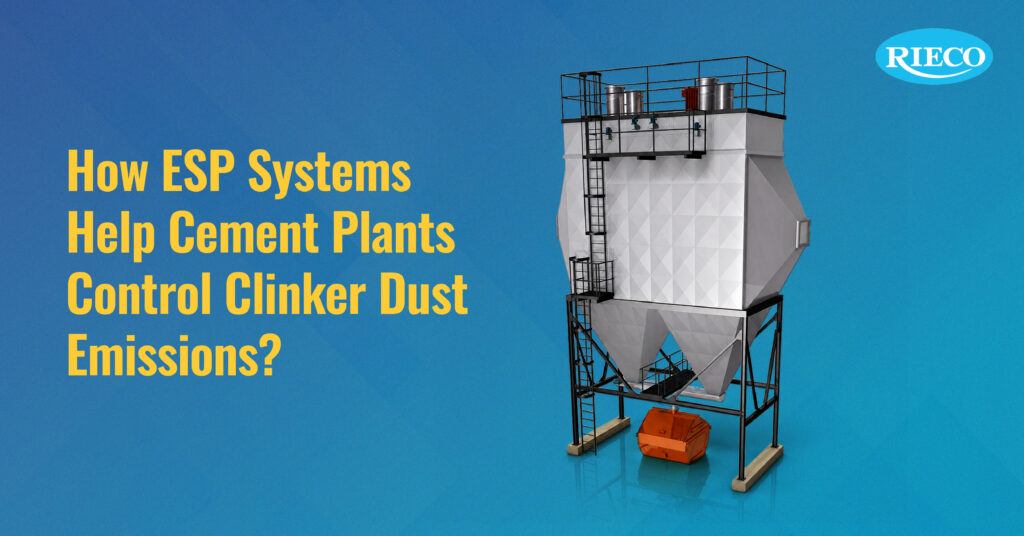
Air Pollution Control
An ESP system for cement plant operations helps capture fine clinker dust and particulate matter from process gases before they are released into the atmosphere. In cement manufacturing, dust is generated at multiple stages, but clinker production and handling create some of the most demanding air pollution control challenges. High gas volumes, elevated temperatures, abrasive dust, and continuous plant operation make efficient emission control essential.
For cement plants, dust control is not only about meeting emission norms. It directly affects air quality, worker safety, equipment reliability, housekeeping, and long-term plant sustainability.
Why Clinker Dust Control is Critical in Cement Plants?
Clinker is produced at high temperatures and then cooled, conveyed, stored, and ground. Each of these stages can release fine particulate matter. Kiln exhaust gases, clinker coolers, crushers, mills, transfer points, and storage systems are all common dust-generating areas in cement plants.
When dust is not controlled properly, it can settle on equipment, reduce visibility, increase maintenance needs, affect nearby work areas, and create environmental compliance risks.
| Dust Challenge | Impact on Cement Plant Operations |
|---|---|
| Fine clinker dust | Can escape with flue gases and affect air quality |
| High dust load | Places stress on pollution control equipment |
| Abrasive particles | Can increase wear in ducts, fans, and internals |
| Fugitive dust | Affects housekeeping and worker comfort |
| Poor collection efficiency | Can lead to emission non-compliance |
| Frequent build-up | Increases cleaning and maintenance downtime |
This is why an efficient industrial dust control system is a core part of modern cement plant design.
What is an Electrostatic Precipitator?
An electrostatic precipitator is an air pollution control device used to remove fine dust particles from flue gas. Instead of using a filter medium, it uses electrical forces to separate dust from the gas stream.
In simple terms, dusty gas enters the ESP. Inside the chamber, discharge electrodes create an electrical field. The dust particles receive an electrical charge and move towards collecting plates with the opposite charge. Once enough dust accumulates on these plates, it is removed through rapping or cleaning mechanisms and discharged into hoppers for collection.
The cleaned gas then exits the system with a much lower dust load.
How an ESP System Works in Clinker Dust Control?
A well-designed ESP system for cement plant applications is engineered around gas volume, temperature, dust load, dust resistivity, moisture, process fluctuations, and required outlet emission levels.
Here is a simple process flow:
| ESP Stage | What Happens |
|---|---|
| Gas inlet | Dust-laden flue gas enters the ESP chamber |
| Gas distribution | Gas flow is spread evenly across the ESP section |
| Charging zone | Dust particles are electrically charged |
| Collection zone | Charged particles migrate to the collecting plates |
| Rapping system | Dust is dislodged from plates at controlled intervals |
| Hopper discharge | Collected dust is removed for handling or reuse |
| Clean gas outlet | Treated gas exits with reduced particulate load |
This makes ESPs suitable for high-volume gas streams commonly seen in kiln and clinker cooler applications.
Why ESPs Suit Cement Plant Air Pollution Control?
A cement plant needs a dust collection system for cement plant operations that can handle tough process conditions. ESPs are widely used because they can manage large gas volumes, high dust loads, and elevated temperatures with comparatively low pressure drop.
This lower pressure drop can support energy-efficient operation because the fan does not need to work against the same resistance as some filtration-based systems. ESPs can also be designed for continuous operation, which is important in cement manufacturing, where process interruptions can affect production targets.
For cement plant air pollution control, the benefits include:
- Better capture of fine particulate matter
- Lower visible emissions from stacks
- Reduced dust release into surrounding areas
- Improved compliance with environmental norms
- Cleaner operating zones around process equipment
- Better protection for fans, ducts, and downstream systems
- Reduced product loss through effective dust recovery
Key Design Considerations for an ESP in Cement Plants
Selecting an ESP is not about choosing just one, perfect size decision. Cement plants operate under demanding and often variable conditions. A reliable system must be designed after studying the process and dust characteristics.
Important parameters include:
| Design Factor | Why It Matters |
|---|---|
| Gas flow rate | Determines ESP size and treatment capacity |
| Dust concentration | Affects the collection area and hopper design |
| Gas temperature | Influences material selection and electrical behaviour |
| Dust resistivity | Impact on charging and collection performance |
| Moisture content | Can affect dust behaviour inside the ESP |
| Required outlet emission | Defines efficiency and design margin |
| Maintenance access | Supports long-term reliability |
| Hopper discharge | Prevents re-entrainment and build-up |
For clinker dust control, these details matter because abrasive dust, fluctuating loads, and continuous operation can affect performance if the system is under-designed.
ESP vs General Dust Collection Systems
Cement plants often use multiple dust control technologies across different sections. Bag filters may be used at transfer points, packaging sections, or local dedusting areas. Cyclones may support coarse dust separation.
ESPs are commonly preferred for large-volume flue gas applications where fine particulate capture is required.
| System | Common Use in Cement Plants |
|---|---|
| ESP | Kiln exhaust, clinker cooler gases, high-volume gas streams |
| Bag filter | Silo vents, packing plants, material transfer points |
| Cyclone separator | Coarse dust pre-separation |
| Dust extraction system | Localised fugitive dust control |
A complete cement plant air pollution control strategy may combine these technologies depending on the process area.
How RIECO Supports Cement Plant Emission Control?
RIECO provides air pollution control solutions designed for industrial applications where reliability, compliance, and long-term performance are critical. Its ESP solutions use static electricity to capture fine particles and pollutants from exhaust gases, supporting cleaner air and controlled emissions.
For cement plants, RIECO’s engineering approach focuses on understanding the process conditions, selecting the right pollution control equipment, and designing systems that can operate consistently in demanding environments.
Along with ESPs, RIECO’s air pollution control portfolio includes bag filters, dust extraction systems, cyclone separators, multiclones, scrubbers, gas cleaning plants, and other clean-air solutions. This makes it possible to build a more complete industrial dust control system for different dust sources within a cement facility.
Conclusion
Clinker dust is one of the most important emission challenges in cement manufacturing. It affects compliance, plant cleanliness, worker safety, equipment life, and the sustainability of operations.
An efficient ESP system for cement plant applications helps capture fine dust from flue gases before they reach the atmosphere. When properly designed, installed, and maintained, an electrostatic precipitator becomes a dependable part of clinker dust control and wider cement plant air pollution control.
For cement manufacturers aiming to reduce emissions, improve compliance, and run cleaner operations, a well-engineered ESP and dust collection system can deliver measurable operational and environmental value.


