

Powder Conveying System Red Flags Every Plant Should Know
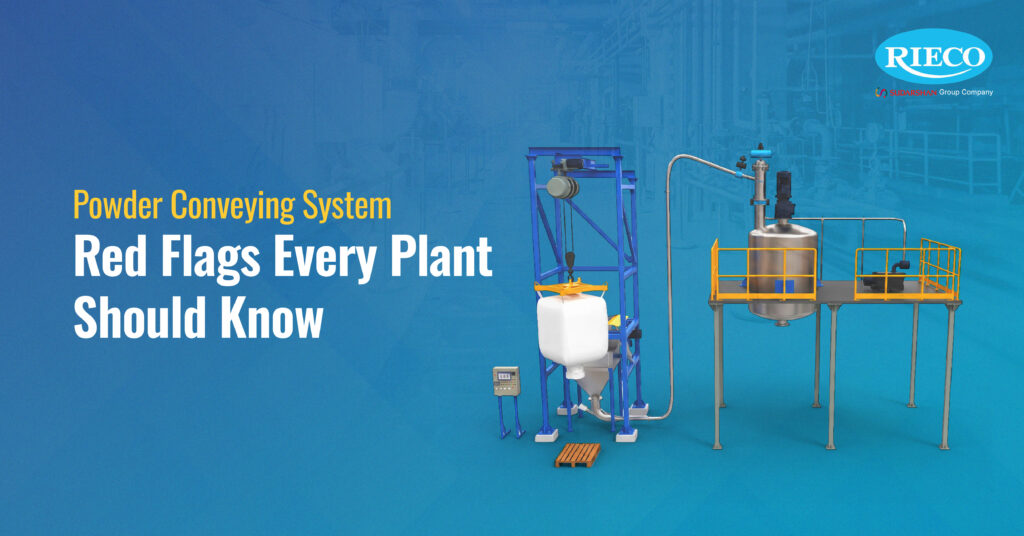
Powder Conveying System
Why do some powder conveying systems run reliably for years while others face recurring blockages, dust leakage and unplanned downtime?
Most powder transport issues do not appear suddenly. They start as small warning signs: unstable flow, rising energy consumption or frequent operator intervention. Recognise these red flags early so they are easier to connect with larger operational failures, and use them to improve conveying system efficiency and reduce maintenance costs.
Why Powder Conveying Problems Often Go Unnoticed
A powder conveying system may continue moving material even when its performance is declining. That is why many plants overlook early symptoms until they affect throughput, safety or product quality.
These issues usually develop due to equipment wear, filter loading, air leakage, material moisture changes or incorrect operating conditions. A structured industrial conveying inspection helps maintenance teams identify the root cause before minor issues become expensive failures.
Red Flag 1: Frequent Airline Blockages
Frequent airline blockages are one of the clearest signs that a conveying system is struggling. Blockages occur when material loses momentum and settles inside the pipeline.
Common causes include low air velocity, excess moisture, sticky powder, overfeeding or poor pipeline routing. Sticky and hygroscopic powders are more likely to block pipelines, especially during humid conditions, making moisture control as important as airflow control.
| Warning Sign | What to Check |
|---|---|
|
Frequent pipeline cleaning |
Conveying velocity |
|
Reduced conveying rate |
Air-to-solids ratio |
|
Pressure fluctuations |
Feeder performance |
|
Material build-up near bends |
Moisture content |
|
Repeated shutdowns |
Bend and elbow condition |
Red Flag 2: Unstable Material Flow
A powder conveying system depends on consistent feeding. If material enters the line unevenly, the entire process becomes unstable.
Unstable flow is often mistaken for a blower or pipeline issue, but the root cause may lie in hopper discharge, rotary valve wear or feeder calibration. In food, pharma and chemical plants, unstable flow can affect batch quality, dosing accuracy and packaging performance.
| Warning Sign | What to Check |
|---|---|
|
Surging flow |
Hopper flow pattern |
|
Irregular discharge |
Rotary valve condition |
|
Inconsistent batch weight |
Feeder calibration |
|
Variation in transfer time |
Material bridging or rat-holing |
|
Poor downstream loading |
Bulk density variation |
Red Flag 3: Excessive Dust Leakage
Dust leakage should not be treated as a housekeeping issue alone. It often indicates pressure imbalance, worn seals, poor filtration or damaged components.
Apart from product loss and cleaning effort, dust leakage can affect workplace safety and environmental compliance. A sealed conveying system loses its core advantage if leakage is ignored.
| Warning Sign | What to Check |
|---|---|
|
Dust around equipment |
Pipe joints and gaskets |
|
Leakage near rotary valves |
Rotary valve clearances |
|
Dust clouds during discharge |
Receiver seals |
|
Frequent filter loading |
Dust collector performance |
|
Reduced pickup efficiency |
Filter cleaning cycle |
Red Flag 4: Rising Energy Consumption
A pneumatic conveying system can keep running while quietly consuming more energy than required. This usually happens when filters clog, air leaks develop, or the blower compensates for pressure losses.
Higher energy consumption is often one of the first hidden signs of poor powder conveying maintenance. Even a small air leak or blocked filter can increase operating cost across every shift.
| Warning Sign | What to Check |
|---|---|
|
Higher blower load |
Filter condition |
|
Increased power consumption |
Air leakage points |
|
Reduced throughput |
Pipeline restrictions |
|
Higher pressure drop |
Blower performance |
|
Longer transfer cycles |
System pressure losses |
Red Flag 5: Premature Equipment Wear
Premature wear on bends, valves and pipelines usually indicates that material is moving too aggressively or the system is not designed for the material’s abrasiveness.
This is common in plants handling minerals, cement, fly ash, carbon black, lime, metal powders or abrasive chemicals. Abrasive or fragile materials often require lower velocities, wear-resistant components or dense phase conveying to improve equipment life.
| Warning Sign | What to Check |
|---|---|
|
Frequent elbow replacement |
Conveying velocity |
|
Pipe wall thinning |
Material abrasiveness |
|
Product leakage |
Wear-prone pipeline sections |
|
Valve wear |
Wear-resistant lining |
|
Higher maintenance frequency |
Dense phase suitability |
When Does a Pneumatic System Redesign Become Necessary?
Maintenance can solve many issues, but not all. A pneumatic system redesign may be required when the existing system no longer matches current plant requirements.
Consider redesign if:
- Production capacity has increased.
- New powders or recipes are introduced.
- Blockages keep recurring
- Energy consumption continues rising.
- Wear remains excessive
- Dust leakage persists
A redesign may involve changes in pipeline routing, feeder selection, conveying mode, blower sizing, filtration, automation or control logic.
Preventive Maintenance Checklist
Strong preventive maintenance for conveyors helps detect problems before they cause downtime.
| Area to Inspect | What to Monitor |
|---|---|
|
Pipeline |
Wear, leakage and build-up |
|
Bends and elbows |
Abrasion and thinning |
|
Rotary valves |
Clearances, seals and air leakage |
|
Filters |
Pressure drop and cleaning cycle |
|
Blower |
Load, vibration and airflow |
|
Feeders |
Calibration and flow consistency |
|
Material |
Moisture, particle size and flowability |
|
Controls |
Pressure trends and alarm history |
Regular inspection improves conveying system troubleshooting, supports stable material flow and protects long-term plant performance.
Conclusion
Powder conveying systems rarely fail without warning. Frequent airline blockages, unstable flow, dust leakage, rising energy consumption and premature wear are all signs that the system needs attention.
With structured powder conveying maintenance, regular industrial conveying inspection and practical conveying system troubleshooting, manufacturers can reduce downtime, improve safety and maintain consistent material handling performance.
At Rieco, we design and optimise pneumatic conveying systems around material behaviour, plant layout, throughput requirements and long-term reliability. If your plant needs troubleshooting support, performance improvement or a complete pneumatic system redesign, contact us to restore efficiency and reliability with the right engineering approach.


