

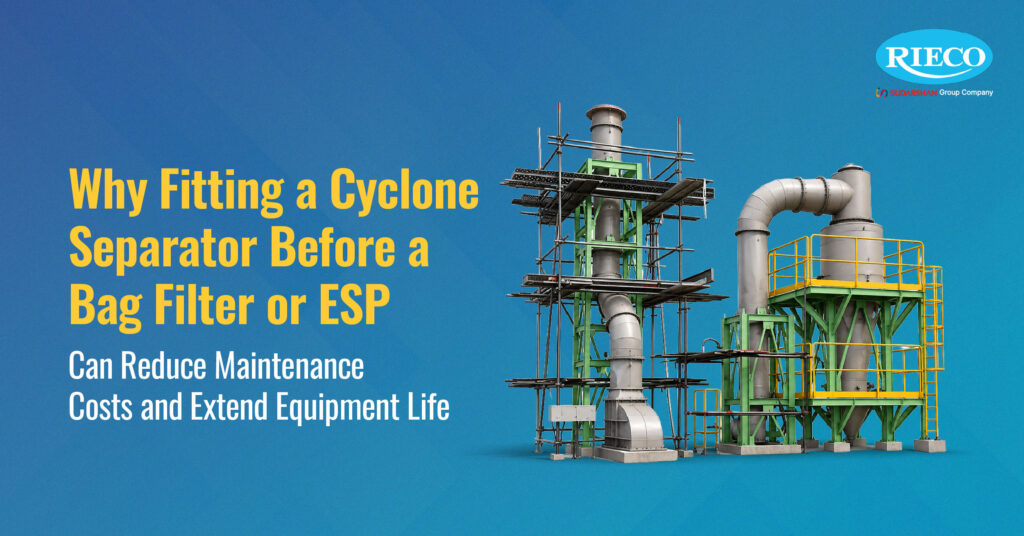
Why Fitting a Cyclone Separator Before a Bag Filter or ESP Can Reduce Maintenance Costs and Extend Equipment Life
Blog
Introduction
A dust collector may be operating within its design limits, yet maintenance teams can still find themselves replacing filter bags too frequently, investigating rising pressure drops, or dealing with excessive dust accumulation. Sometimes, the problem is not the final collector itself. It is the amount and type of dust reaching it in the first place.
In industries such as cement, steel, mineral processing, and grinding, exhaust gases can carry substantial quantities of coarse or abrasive particles. Sending this entire dust load directly to a bag filter or electrostatic precipitator (ESP) can increase the workload on downstream equipment, particularly when the incoming dust contains particles that could have been separated earlier.
Installing a cyclone separator before a bag filter or ESP introduces an additional stage of mechanical separation. By removing a portion of the larger particles upstream, a cyclone can reduce the particulate load reaching the final collector, potentially lowering maintenance requirements and wear.
However, the benefits depend on the particle-size distribution, gas flow, operating conditions, and cyclone design. Understanding these factors helps plant operators determine when a pre-separator dust collection system can deliver meaningful operational and lifecycle benefits.
What Is a Cyclone Separator, and How Does It Work Before a Bag Filter?
A cyclone separator is a mechanical dust collector that uses centrifugal and inertial forces to separate particles from a gas stream. Installed upstream of a bag filter or ESP, it acts as a pre-cleaner, removing a portion of the larger or denser particles before the gas reaches the final collection equipment.
How does a dust pre-separation system work?
A typical cyclone-based dust pre-separation system follows five steps:
- Dust-laden gas enters the cyclone: The inlet arrangement directs the gas into a rotational flow pattern.
- Particles move towards the cyclone wall: Centrifugal and inertial forces drive particles towards the outer wall, depending on their size, density, and aerodynamic behaviour.
- Separated dust enters the hopper: Particles slide or fall into the collection section at the bottom of the cyclone.
- The gas exits through the outlet: The gas stream leaves with a reduced concentration of the particles captured by the cyclone.
- The downstream collector captures remaining dust: The bag filter or ESP removes the finer and residual particulate matter.
The cyclone does not eliminate the need for final filtration or electrostatic precipitation. Its purpose is to reduce the load reaching that equipment.
Unlike a bag filter, a conventional cyclone does not rely on filter media. Its relatively simple construction and lack of moving parts within the separation chamber can also make routine maintenance less demanding, although the hopper, discharge equipment, internal surfaces, and casing still require inspection.
Why Should You Install a Cyclone Separator Before a Bag Filter?
A cyclone separator before a bag filter is particularly useful when the incoming gas contains a significant proportion of coarse or abrasive dust. Removing part of this material upstream can reduce the mass of dust reaching the filter bags and may help limit abrasion, excessive dust accumulation, and cleaning demand.
How can a cyclone reduce bag filter maintenance?
A bag filter captures particles as contaminated gas passes through its filter media. As dust accumulates, the resulting dust cake increases resistance to airflow, making periodic cleaning necessary. High dust loading can accelerate cake formation, while coarse abrasive particles can contribute to premature bag damage in certain applications.
A properly selected cyclone can address some of these issues before the gas reaches the baghouse.
| Bag filter challenge | How upstream cyclone separation can help |
|---|---|
| High incoming dust load | Removes a portion of the coarse particulate mass before filtration. |
| Abrasive particle impact | Reduces exposure to the particles captured by the cyclone, potentially lowering abrasion at vulnerable locations. |
| Rapid dust accumulation | Can reduce the quantity of dust reaching the filter media, depending on separation efficiency. |
| Frequent cleaning cycles | May reduce cleaning demand when the lower dust load meaningfully reduces dust-cake formation. |
| Premature bag replacement | Can improve bag service life when coarse-particle abrasion or excessive dust loading is a significant cause of failure. |
| High system resistance | May help manage filter loading, but the cyclone’s additional pressure drop must also be considered. |
These benefits are not automatic. A cyclone adds resistance to the gas path, and bag life also depends on filter media selection, temperature, moisture, chemical compatibility, air-to-cloth ratio, and cleaning settings.
The objective is to reduce avoidable loading without creating excessive pressure drop or compromising the downstream collector’s performance.
Can a Cyclone Separator Extend the Service Life of an ESP System?
A cyclone separator can reduce the amount of coarse particulate matter entering an electrostatic precipitator (ESP), potentially lowering the coarse-dust burden on downstream equipment. However, extending ESP service life is application-dependent: the benefits depend on particle characteristics, operating conditions, dust-discharge performance, and the causes of existing maintenance problems.
What role does a cyclone play in a cyclone separator ESP system?
In a cyclone separator ESP system, the cyclone acts as a preliminary separation stage, while the ESP remains responsible for collecting the remaining particulate matter.
An ESP uses an electrical field to charge particles and collect them on oppositely charged surfaces. Its performance depends on factors including particle properties, gas conditions, electrical operation, and the characteristics of the dust layer on collection surfaces.
The cyclone can support this arrangement by reducing the incoming load of particles it is capable of separating. Depending on the application, this may help reduce coarse-dust accumulation and the burden on associated collection and discharge components.
Potential benefits include:
- Reduced particulate loading: Less of the cyclone-captured dust reaches the ESP.
- Lower coarse-dust accumulation: The cyclone diverts part of the incoming particulate mass into a separate collection hopper.
- Reduced exposure to abrasive particles: Separating coarse, abrasive material upstream may reduce wear in susceptible downstream components.
- Better distribution of collection duties: The cyclone handles the fraction it can separate effectively, while the ESP deals with the remaining particles.
It is important not to assume that a cyclone will automatically improve ESP electrical performance or reduce rapping frequency. Those outcomes depend on the specific ESP design and operating conditions. The case for installing a cyclone should be based on measurable dust-loading, wear, maintenance, and energy considerations.
How Much Dust Can a Cyclone Separator Remove Before Final Collection?
Cyclone efficiency varies with particle size, density, gas velocity, and equipment geometry. Conventional cyclones are generally more effective at collecting larger particles than fine particulate matter, which is why they are commonly used as pre-cleaners rather than as the only emission-control device.
The U.S. Environmental Protection Agency (EPA) explains that cyclones are often used to collect particles larger than approximately 10 micrometres and reduce the inlet loading on downstream collection equipment. High-efficiency designs can capture smaller particles, but usually at the cost of greater pressure drop and energy consumption.
How does particle size affect cyclone performance?
| Particle characteristics | Expected cyclone performance | Implication for system design |
|---|---|---|
| Larger, denser particles | Generally easier to separate | Often suitable for primary pre-separation. |
| Medium-sized particles | Performance depends on particle properties and cyclone design | Evaluate the particle-size distribution and required removal efficiency. |
| Fine particles | Generally more difficult to capture | Retain a suitable downstream bag filter or ESP for final collection. |
| Sticky or cohesive dust | May adhere to internal surfaces or obstruct discharge arrangements | Assess material behaviour and cleaning requirements before selection. |
| Abrasive particles | May be separated effectively, but can wear internal surfaces | Evaluate wear-resistant construction and inspection access. |
These categories are directional rather than guaranteed performance bands. Actual removal efficiency should be established for the application using the gas-flow conditions, particle-size distribution, and selected cyclone configuration.
How Do You Size a Cyclone Separator for Industrial Dust Collection?
A cyclone separator sizing guide should start with the required gas flow rate, particle-size distribution, dust loading, operating temperature, and allowable pressure drop. The design must balance separation performance against energy consumption, wear, space requirements, and the capacity of the downstream bag filter or ESP.
Selecting a cyclone based on duct diameter or nominal airflow alone can lead to poor separation performance or unnecessary operating costs.
Which parameters should engineers evaluate?
| Design parameter | Why it matters |
|---|---|
| Gas flow rate | Determines the cyclone’s required capacity and influences inlet velocity. |
| Particle-size distribution | Helps estimate which fraction of the dust can be separated effectively. |
| Dust loading | Establishes the incoming particulate mass and the potential benefit of pre-separation. |
| Particle density and shape | Affect particle movement and separation behaviour. |
| Gas temperature and composition | Influence gas properties, material selection, and operating constraints. |
| Pressure drop | Affects fan static-pressure requirements and energy consumption. |
| Dust abrasiveness | Influences internal wear, material selection, and inspection intervals. |
| Dust discharge characteristics | Determines the suitable hopper, airlock, rotary valve, or other discharge arrangement. |
| Downstream collector capacity | Ensures that the bag filter or ESP can handle the remaining gas and particulate load. |
| Installation space | Influences the cyclone configuration, duct routing, and maintenance access. |
Why is pressure drop important when selecting a cyclone?
Higher inlet velocity can improve particle separation in a cyclone, but it also increases pressure drop. The additional resistance can increase fan energy consumption, so the highest possible collection efficiency is not necessarily the most economical design.
Engineers should calculate the pressure drop across the cyclone and include it in the total system pressure requirement. They should also assess the performance of the downstream collector at the resulting gas flow and operating conditions.
For an existing plant, a pre-separator assessment should compare the expected reduction in downstream maintenance with the added capital cost, pressure drop, energy use, and maintenance needs of the cyclone itself.
How Can a Cyclone Separator Reduce Total Dust Collection Costs?
A cyclone can reduce the lifecycle cost of a dust collection system when the maintenance and operational benefits outweigh its installation, energy, and servicing costs. The strongest business case usually occurs where a significant fraction of the incoming dust is readily separable and the downstream equipment experiences problems associated with high dust loading or abrasive particles.
Which costs should a plant evaluate?
- Filter media replacement
If abrasive particles or excessive loading contribute to premature bag failure, upstream separation may reduce one source of wear. However, it will not correct failures caused by incompatible filter media, excessive temperature, chemical attack, poor installation, or incorrect cleaning settings. - Cleaning-system consumption
Lower dust loading may reduce cleaning demand in some baghouses. The actual reduction in compressed-air consumption depends on the baghouse design, cleaning controls, dust properties, and operating conditions. - Maintenance labour and downtime
If pre-separation reduces the frequency of bag changes, internal cleaning, or dust-handling interventions, maintenance teams may spend less time on those tasks. The result should be assessed using actual maintenance records rather than assumed savings. - Fan energy consumption
The cyclone introduces additional pressure drop. Although a lower downstream filter pressure drop may offset part of this resistance, the overall energy effect must be calculated for the complete system. - Equipment wear and dust discharge
Cyclone internal surfaces and discharge components also require inspection. Abrasive dust can cause erosion, while poor discharge arrangements can lead to accumulation or re-entrainment. These requirements should be included in the lifecycle cost calculation.
How should plants estimate the return on investment?
Before approving a cyclone installation, compare the existing system’s operating costs with the projected costs after adding the pre-separator.
| Cost or performance indicator | What to measure |
|---|---|
| Bag replacement | Annual bag consumption, replacement cost, and failure causes |
| Cleaning system | Compressed-air use, cleaning frequency, and associated energy costs |
| Maintenance labour | Hours spent on bag changes, cleaning, inspections, and corrective work |
| Downtime | Lost production attributable to dust collection maintenance |
| Fan energy | Power consumption before and after accounting for the cyclone’s pressure drop |
| Cyclone maintenance | Inspection, wear-part replacement, hopper cleaning, and discharge equipment servicing |
| Capital expenditure | Equipment, ducting, structural work, installation, and commissioning |
The business case should use site-specific data. Without that information, it is not possible to credibly promise a particular percentage reduction in maintenance costs or increase in equipment life.
When Is a Cyclone Pre-Separator Not the Right Choice?
A cyclone pre-separator is not automatically beneficial for every dust collection application. It is less attractive when the incoming dust contains very little coarse material, when the existing collector already operates reliably at a manageable loading, or when the additional pressure drop and installation cost outweigh the expected maintenance savings.
A detailed assessment is particularly important when handling sticky or cohesive dust, which can accumulate inside the cyclone or interfere with reliable discharge.
Which applications are suitable for pre-separation?
A cyclone may be worth evaluating in applications such as:
- Cement and mineral processing, where exhaust streams can contain coarse particulate matter.
- Grinding and pulverising operations that generate dust with an abrasive fraction.
- Biomass and boiler exhaust applications where the dust characteristics and operating temperatures are compatible with cyclone separation.
- Metal processing and steel operations where the particle-size distribution supports mechanical pre-collection.
- Industrial material handling systems with dust-laden exhaust streams and significant coarse-particle loading.
These are potential applications, not automatic recommendations. The material characteristics, gas conditions, required emission performance, and applicable regulatory limits should guide equipment selection.
How Can You Select a Cyclone Separator Manufacturer in India?
When evaluating a cyclone separator manufacturer in India, look for evidence of application-specific engineering rather than selecting equipment solely on nominal capacity or purchase price. The supplier should understand the dust characteristics, gas flow, pressure-drop limits, operating environment, and requirements of the downstream collection equipment.
For industrial dust collection in India, the cyclone must also be compatible with the plant’s layout, maintenance practices, environmental obligations, and operating conditions.
What should you ask a supplier before finalising a system?
- Can the supplier assess particle-size distribution and incoming dust loading?
- What collection efficiency is expected for the actual operating conditions?
- How much pressure drop will the cyclone introduce?
- How will abrasive wear, dust discharge, and potential accumulation be managed?
- Can the cyclone be integrated with the existing bag filter or ESP?
- What inspection, maintenance, and access provisions are included?
- What information supports the projected maintenance or energy savings?
RIECO offers industrial cyclone separators for air pollution control, including different cyclone configurations for application-specific particle separation. Its multiclone dust collectors provide another option where multiple smaller cyclones are used to handle particulate-laden gas streams. The appropriate configuration depends on the application and should be assessed against the complete system requirements.
To Sum Up
When a bag filter requires frequent maintenance, the immediate response is often to inspect the bags, cleaning system, and operating settings. Those checks are essential, but they may not address the full problem if a large quantity of coarse or abrasive dust is reaching the collector in the first place.
A properly designed cyclone separator provides an opportunity to address that problem earlier in the process. By separating a portion of the incoming particulate matter, it can reduce the workload on downstream equipment and potentially lower maintenance requirements where high dust loading or abrasion is a significant concern.
The decision, however, should not rest on the assumption that adding another piece of equipment will automatically reduce operating costs. Engineers must compare the expected reduction in downstream maintenance with the cyclone’s pressure drop, energy demand, capital cost, and own maintenance requirements.
The practical takeaway is simple: assess the dust before investing in the collector. When particle characteristics and operating data show that pre-separation is worthwhile, a cyclone can become a valuable first stage in a more reliable and cost-effective industrial dust collection system.
Frequently Asked Questions
Does a cyclone separator before a bag filter extend filter bag life?
It can, particularly when coarse or abrasive particles contribute to premature bag wear or excessive dust loading. A cyclone removes only the fraction it can separate effectively, so the benefit depends on the dust characteristics and operating conditions. Bag life also depends on filter media selection, temperature, moisture, cleaning settings, and installation quality.
Can a cyclone separator replace an ESP or bag filter?
No. A cyclone is generally more effective at removing larger particles than fine particulate matter. A bag filter or ESP is commonly retained as the final collection stage to capture the remaining dust and meet the required emission performance. The appropriate arrangement depends on the process, gas stream, and applicable regulatory requirements.
Does installing a cyclone separator reduce energy consumption?
Not necessarily. A cyclone adds pressure drop, which can increase fan energy consumption. It may also reduce downstream loading and help manage filter resistance in some applications. The overall energy impact should be calculated using the complete system’s pressure losses, airflow requirements, and operating profile.
Which industries benefit most from cyclone pre-separation?
Cement, mineral processing, grinding, pulverising, metal processing, and selected boiler or biomass applications may benefit when their dust streams contain a significant coarse or abrasive fraction. Suitability depends on particle-size distribution, gas conditions, required collection efficiency, and the performance of the existing downstream equipment.
What information is needed to size an industrial cyclone separator?
Key inputs include gas flow rate, dust loading, particle-size distribution, particle density, temperature, gas composition, allowable pressure drop, and dust discharge characteristics. Engineers should also review the downstream bag filter or ESP specifications and available installation space. These details help establish a suitable cyclone configuration and realistic performance expectations.


