

ACM vs Hammer Mill vs Jet Mill: How Engineers Select the Right Grinding Technology
Grinding Solution
Choosing the right milling equipment often feels like a high-stakes balancing act between particle size, energy costs, and material sensitivity. If you pick a mill that is too powerful, you waste energy and risk damaging the product. If it is too weak, you never hit your target fineness.
For engineers in the chemical, food, and pharmaceutical sectors, the choice usually comes down to three heavy hitters. This guide breaks down the practical differences to help you decide which technology fits your specific production line.
The Workhorse: Hammer Mills
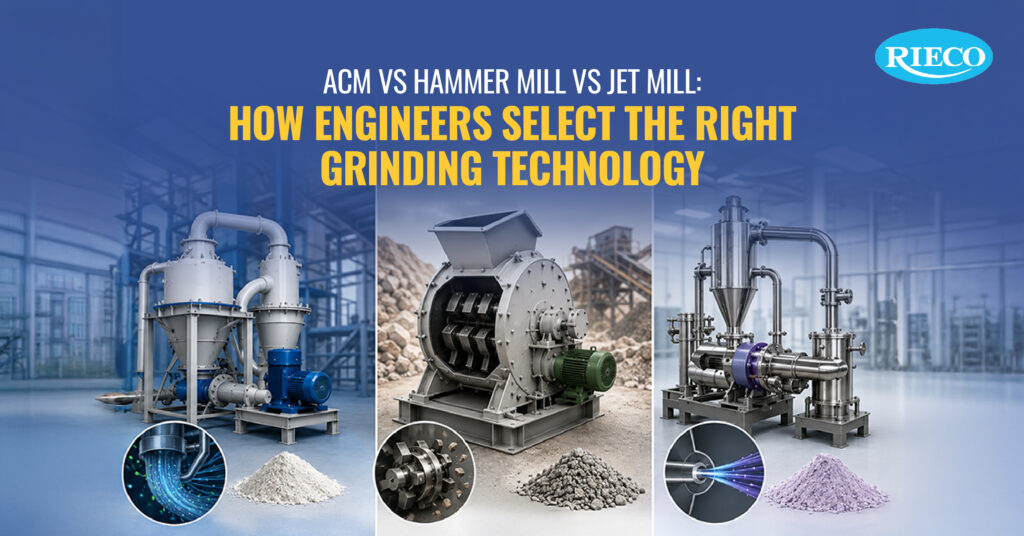
Hammer mills are the go-to for general-purpose grinding. They operate on a simple principle of high-speed impact. A series of hinged hammers strike the material until it is small enough to pass through a screen at the bottom.
If you need to turn spices, minerals, or grains into coarse powders or granules, this is your best bet. It is rugged and easy to fix. However, because it relies on a physical screen, it can struggle with heat-sensitive materials. The friction can cause the product to melt or degrade if you try to push it too fine.
The Precision Tool: Air Classifying Mills
When you need to go finer than a standard screen allows, the ACM vs Hammer Mill vs Jet Mill debate shifts toward the Air Classifying Mill (ACM).
The ACM is a hybrid. It grinds material using a rotor but adds an internal air classifier. Instead of a screen, a spinning wheel uses centrifugal force to sort particles. If a particle is too big, it goes back for more grinding. If it is small enough, the air carries it out. This allows you to hit a very narrow particle size distribution, often down to 10 or 20 microns, without the heat buildup of a hammer mill.
The Ultra-Fine Specialist: Jet Mills
When even an ACM isn’t enough, you move to the Jet Mill. This technology does not use any moving parts like hammers or rotors. Instead, it uses high-pressure compressed air or gas to make particles collide with each other.
This process, known as fluid energy milling, is the gold standard for heat-sensitive pharmaceuticals or chemicals that need to be below 5 microns. Because there are no grinding media, there is zero risk of metal contamination. It is more expensive to run due to the compressed air requirements, but for ultra-fine applications, nothing else works as well.
Comparison: ACM vs Hammer Mill vs Jet Mill
| Feature | Hammer Mill | Air Classifying Mill (ACM) | Jet Mill |
| Grinding Method | Mechanical Impact | Impact + Air Classification | Particle-on-Particle Attrition |
| Final Size | 50 to 100+ Microns | 10 to 45 Microns | 1 to 10 Microns |
| Heat Generation | High | Managed (Air Cooled) | Low (Cooling via expansion) |
| Maintenance | Frequent (Screens/Hammers) | Moderate | Low (No moving parts) |
| Material Type | Friable, non-oily | Heat-sensitive, chemicals | High purity, abrasive |
How to Select Your Technology
Choosing between an ACM vs Hammer Mill vs Jet Mill requires looking at your material’s physical properties first.
1. Check Your Fineness Target
If your spec sheet says “90% passing 500 microns,” a hammer mill is efficient and cost-effective. If you need a “D97 of 20 microns,” you should look at an ACM. For anything requiring sub-10 micron precision, the jet mill is the only real contender.
2. Consider Heat Sensitivity
Sugars, resins, and many pharmaceutical ingredients melt if they get too hot. Hammer mills generate significant heat. ACMs use a high volume of air, which helps keep temperatures stable. Jet mills actually provide a cooling effect as the compressed gas expands, making them perfect for low-melting-point materials.
3. Factor in Maintenance and Cleaning
Hammer mills require regular screen changes. ACMs have more internal components to clean, but offer better access through clam-shell designs. Jet mills are the easiest to clean because they have no rotating shafts or bearings in the grinding zone, which is a major plus for food-grade or sterile environments.
The RIECO Advantage: More Than Just Machines
At RIECO, we know that selecting a mill is about more than just reading a spec sheet. With over 45 years of experience and more than 5,000 installations worldwide, we have seen almost every material challenge imaginable. We don’t just supply equipment; we provide engineered solutions.
Whether you are looking for a standalone hammer mill for heavy-duty spice grinding or a fully automated, closed-loop ACM system for explosive chemicals, we tailor our technology to your specific process. Our pilot plant testing ensures that the equipment you choose will perform exactly as expected before it ever reaches your floor.
If you are ready to optimize your grinding process or need a technical consultation to settle the ACM vs Hammer Mill vs Jet Mill debate for your specific application, our team is here to help. Reach out to RIECO today to find the most efficient path to your target particle size.


