

How Steam Sterilization Machines Work in Food and Spice Processing
Food / Spice
Food processing today operates under a different level of scrutiny than it did a decade ago. Global supply chains, strict import regulations, and rising consumer awareness have made food safety a non-negotiable requirement. For industries dealing with spices, herbs, and bulk powders, the challenge is even more complex. These products are naturally exposed to environmental contaminants during harvesting, drying, and storage.
This is where the role of a steam sterilization machine comes into conversation. It acts as the final safety checkpoint before products enter packaging and distribution. But the expectation is not just safety. Processors also need to retain the natural characteristics of their products, like flavor, aroma, and color, while meeting international compliance standards. This balance between microbial safety and product quality is exactly where Rieco Industries Limited, in collaboration with ETIA (France), has positioned its advanced steam sterilization technology.
What is a Steam Sterilization Machine?
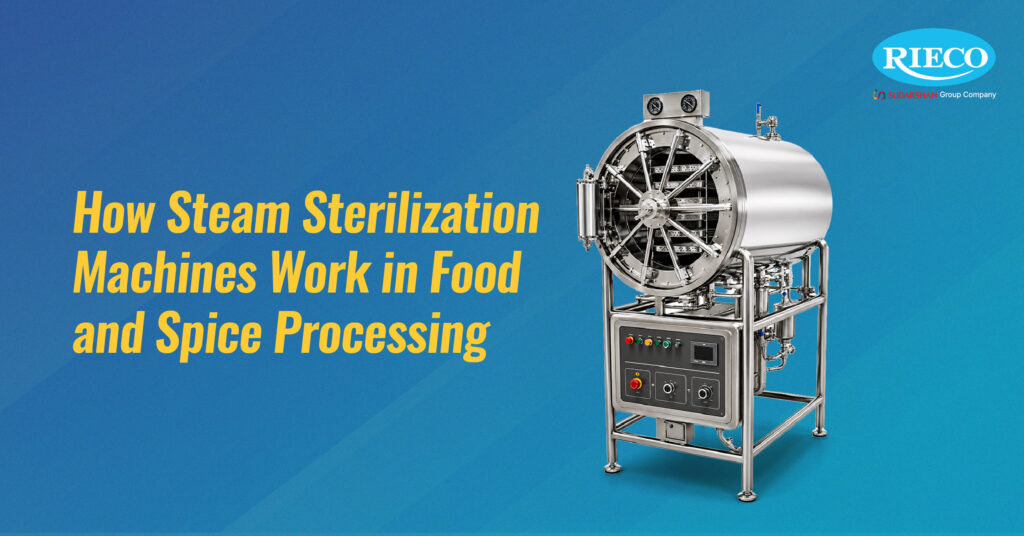
A steam sterilization machine is used to eradicate microorganisms from food products using controlled steam and heat. It relies on moist heat transfer, where steam condenses on the surface of the material and releases energy that destroys bacteria, molds, and pathogens.
In food applications, this method is widely preferred because it avoids chemical additives. It uses thermal energy in a safe environment to guarantee the product’s safety rather than changing it. For spice processors and ingredient manufacturers, this becomes especially important. Contaminants such as Salmonella or E. coli are commonly associated with raw agricultural materials, and without proper sterilization, they can pose serious risks across the supply chain.
How Does a Steam Sterilization System Work?
A steam sterilization system operates by controlling four key variables: temperature, time, moisture, and pressure. These parameters are adjusted to create conditions where microbial life cannot survive.
The process begins with heating, where steam replaces air in the treatment chamber. This makes sure that the product touches all over the same way. Once the desired temperature is reached, the sterilization phase begins, where pathogens are inactivated through protein denaturation.
After this, the product is cooled in a controlled manner to stabilize it for further processing.In industrial food processing, the challenge is not just achieving sterilization, but doing it consistently across large volumes. This is where system design plays a major role.
What Happens Inside a Modern Continuous Steam Sterilization Machine?
Modern processing facilities rely on continuous steam sterilization machines rather than batch-based systems. This shift improves efficiency and ensures uniform treatment. In systems like the ETIA x Rieco SPIROJOULE BT 450, the process is set up as a smooth flow:
- Controlled Feeding: Raw material enters the system at a regulated rate, ensuring consistency from the start.
- Electrically Driven Heating: The core of the system is the Spirajoule, an electrically heated screw conveyor that can reach temperatures up to approximately 250°C. This allows direct heat transfer to the product.
- Steam Integration: Steam is injected into the chamber in a controlled manner. The combination of heat and moisture creates an environment where pathogens are eliminated almost instantly.
- Continuous Movement: The product moves steadily through the system, ensuring uniform exposure without interruptions.
- Rapid Cooling: A dry flash-cooling stage brings the product temperature down quickly, preventing over-processing and preparing it for packaging.
This design enables high-capacity processing up to 500 kg per hour while maintaining precision at every stage.
Why is Steam Sterilization Important in Food Processing?
Spices and food powders are particularly vulnerable to contamination due to their exposure to open environments. Without effective sterilization in food processing, these materials can carry microbial loads that affect both safety and shelf life.
Steam sterilization is an important step in quality control that makes sure of the following:
- Reduction of harmful pathogens
- Improved product stability
- Compliance with international food safety regulations
For export-oriented businesses, this is essential. Many markets have strict microbial limits, and failure to meet them can result in rejected shipments and financial losses.
How Does It Preserve Quality While Ensuring Safety?
One of the key concerns with any sterilization method is its impact on product quality. Excessive heat or prolonged exposure can damage essential oils, alter color, and reduce the overall appeal of spices.
Advanced steam sterilization machines address this through precision control. Instead of prolonged heating, they use short, targeted exposure to achieve microbial reduction.
In the Safesteril technology used by Rieco:
- Heat is applied uniformly through the Spirajoule system
- Steam penetration is controlled to avoid excess moisture
- Residence time is optimized to prevent degradation
This results in minimal loss of volatile oils and better retention of natural characteristics. For processors supplying premium markets, this balance is critical.
Where Does Industrial Equipment Like SPIROJOULE Fit In?
Industrial food processing is moving toward systems that are continuous, scalable, and efficient. Equipment like the SPIROJOULE BT 450 is designed to integrate directly into such environments. It offers:
- Continuous processing instead of batch cycles
- Chemical-free sterilization
- Consistent microbial reduction
- High throughput suitable for large-scale operations
Beyond the technical capabilities, there is also a strong economic advantage. Through its collaboration with ETIA, Rieco has made this advanced technology available in India at a significantly lower cost compared to similar international systems. This opens up access for spice processors, food ingredient manufacturers and export-focused companies
It allows them to adopt high-end sterilization technology without the traditional cost barriers.
Conclusion
A steam sterilization machine has become a core component in modern food processing. It assures that products are safe, compliant, and ready for global markets without compromising their natural qualities.
As the industry continues to evolve, the focus is diverting toward systems that combine efficiency, and sustainability. Continuous steam sterilization systems represent this shift, offering a practical solution for large-scale operations.
With solutions like the SPIROJOULE BT 450, Rieco Industries Limited is bringing advanced sterilization technology within reach of Indian processors. The result is a more scalable and quality-focused approach to food safety in hand with the expectations of both regulators and consumers.
Get in touch with us at [email protected]


