

Common Plant Design Mistakes That Bulk Material Testing Can Prevent
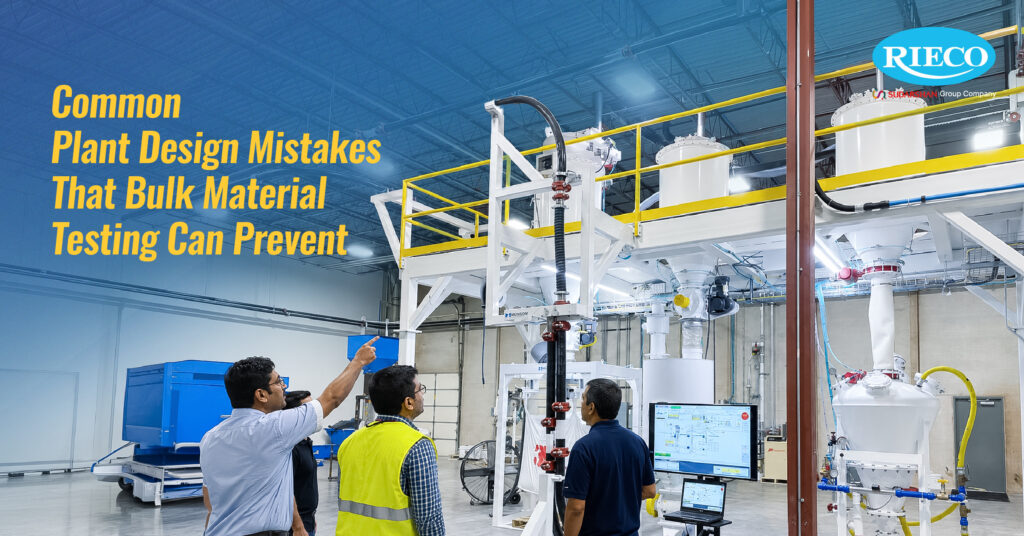
Bulk Material Handling
Design decisions are often locked in long before the material is fully understood in bulk processing plants. Equipment is selected, layouts are finalised, and only during commissioning do the real problems begin to surface.
Blockages, inconsistent flow, segregation, and downtime are not random failures. They are often the result of design decisions made without understanding how the material behaves.
Bulk material testing becomes vital at this point. It helps identify potential risks at the design stage, preventing costly corrections later. For industries handling powders, spices, and fine materials, this step is not optional. It is foundational.
Why Plant Design Fails Without Material Understanding
A plant is only as good as the material flow within it. When material behaviour is assumed rather than measured, systems are built on uncertainty.
Two powders may look identical but behave completely differently under pressure, humidity, or flow conditions. Without testing, these differences remain hidden until they disrupt operations.
This leads to bulk material handling problems that are difficult and expensive to fix once the plant is operational.
Mistake 1: Incorrect Hopper Design
Hopper design is one of the most common areas where assumptions fail. Without proper data, hoppers are often designed with incorrect angles or outlet sizes. This results in classic hopper design issues such as arching and ratholing.
When material stops flowing, operators are forced to intervene manually, affecting both safety and productivity. Bulk material testing provides flowability and cohesion data, which helps in designing hoppers that promote consistent discharge.
Mistake 2: Ignoring Material Flow Variability
Materials do not behave the same way all the time. Changes in moisture, temperature, or particle size can alter flow behaviour greatly. Ignoring this variability leads to material flow problems, especially in continuous systems where consistent behaviour is critical.
Testing materials under different environmental conditions helps predict these variations and design systems that can handle them.
Mistake 3: Poor Feeder Selection
Feeders are responsible for controlling how material enters the process. Selecting the wrong type of feeder can lead to uneven flow, surges, or starvation. These issues directly affect downstream equipment, causing inefficiencies and quality variations.
With bulk material testing, parameters like bulk density and compressibility are understood in advance, allowing for accurate feeder selection.
Mistake 4: Overlooking Powder Cohesion and Segregation
Fine powders often exhibit cohesive behaviour. This can lead to clumping, bridging, or uneven flow. Segregation is another issue, where particles separate based on size or density. This affects product consistency and quality.
These powder handling problems are difficult to detect without testing. Once they occur in a running plant, correcting them may require redesigning entire sections.
Mistake 5: Designing for Equipment Instead of Material
A common approach in plant design is to select equipment first and adjust the process around it. This often leads to mismatches between machine capability and material behaviour. The result is inefficient operation and frequent breakdowns.
Bulk material testing changes this approach. It starts with understanding the material and then selecting equipment that fits its behaviour.
Mistake 6: Underestimating Discharge and Storage Challenges
Storage systems like silos and bins are often treated as static components. In reality, they are dynamic systems where material behaviour plays a critical role. Poorly designed discharge systems lead to:
- Inconsistent flow
- Material build-up
- Increased downtime
Testing helps determine the right design parameters for storage and discharge, reducing these risks.
How Bulk Material Testing Solves These Issues
Bulk material testing provides data-driven insights into:
- Flowability and cohesion
- Bulk density and compressibility
- Moisture sensitivity
- Shear strength
This allows engineers to design systems that match real material behaviour rather than theoretical assumptions. The result is stable material flow, reduced downtime, improved process efficiency, and better product consistency.
Conclusion
Most plant design mistakes are not due to poor engineering. They are due to missing data about how materials behave.
By incorporating bulk material testing at the design stage, manufacturers can avoid common bulk material handling problems, reduce operational risks, and build systems that perform reliably over time. This becomes especially important in storage and discharge systems. Solutions like Rieco Silo Storage and Discharge Systems rely heavily on accurate flow data to function effectively. Without proper testing, issues like arching, ratholing, and inconsistent discharge can disrupt the entire process.
Designing with material insight rather than assumption is what separates successful plants from problematic ones.


