| |
|
|
| |
 |
| |
| |
| CLINKER COOLER POLLUTION CONTROL SYSTEM |
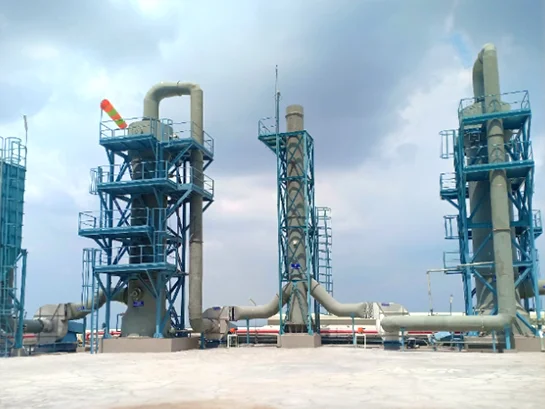
Traditionally on Clinker Cooler Application Gas Conditioner and Electrostatic precipitator combination was used world over. However in certain areas where water is scare, use of Conditioner is a big constraint. Also Air Pollution control Norms are getting stringent day by day which ESP is unable to meet. Similarly efficiency of ESP is not consistent under changing Inlet Conditions.
RIECO provided answer to the problem at Gulf Cement Company Ras-Al-Khaima UAE by supplying Cooler Bag Filter combination for Clinker Cooler Application. The system is performing satisfactorily meeting Stringent Emission Control Norms. |
| |
| Customer/User |
GULF CEMENT COMPANY Ras-Al-Khaima UAE
Through Thyssenkrupp Industries India |
| Year of Manufacturing |
2005 |
| COOLER DETAILS |
|
| Tubular Cooler Type |
Indirect Contact, Cross Flow |
| Application |
To Cool Hot Air From Clinker Cooler |
| Cooling Media |
Forced Draft of Atmospheric Air |
| Hot Gas Flow Rate |
423000 Nm3/hr |
| Hot Gas Inlet Temperature |
| Operating Condition |
300°C |
|
| |
|
| Hot Gas Outlet Temperature |
120°C |
| Cooling Air Inlet Temperature |
50°C (max) |
| BAG FILTER DETAILS |
|
| Bag Filter Type |
Pulse Jet |
| Gas Flow Rate |
6,40,000 m3/hr |
| Dust Load Inlet |
20 gm/m3 |
| Dust Load Outlet |
Less than 15 mgm/Nm3 |
| Gas Temperature |
120° C |
| Filter Cloth Area (total) |
7920 m2 |
| Number of Chambers |
4 No’s |
| Number of Filter Bags / Chamber |
660 No's |
| Filtration Velocity |
1.35 m3/min/m2 |
|
| |
|
| |
| Pneumatic Conveying system for decorative paint industry |
| Company duplicates Pneumatic Conveying success at Ankleshwar & Patancheru Plant, India. Hence, we carried the case study jointly.Asian paints Industries Ltd., Mumbai manufacturers and markets decorative paints and industrial paints. In fact, the company is a market leader in decorative paints both distemper as well as emulsion paints. The company has a market share of over 65% of the decorative paints in India. Asian Paints has its largest manufacturing facility at Ankleshwar, Gujarat. Asian Paints also has factories at Patancheru, Kasna, and Cuddalore, Sri Lanka. |
| |
| Batch Operations |
Manufacturing distemper as well as emulsion paints requires batching, solids conveying &mixing as many as 22 ingredients, each in the exact proportion as required by the type of paint manufactured. To change the recipes quickly, Asian Paints manufactures the paints in batches. First the 22different solids in powder form are weight – batched to a bag unloading station hopper. The solids are available in 25 kgs / 50 kgs poly bags & are bought near the unloading hopper on pellets. The entire charging operation was earlier carried out manually using lifts and forklifts for handling of raw material bags.
This led to plenty of dusting and wastages also at the cost of accuracy of recipe. RIECO installed a fully mentioned pneumatic transport system along with necessary dust control equipments. The conveying system components are specially designed to suit the properties of 22 odd raw materials used including certain difficult materials such as TiO2 and steatite. After verifying the weight, the solids are charged into bag unloading station hopper, from this hopper the solids are pneumatically conveyed @ a rate of 11 TPH and 80 mtrs. long to 12 storage hoppers located above each pug mill.
The pneumatic conveying is a lean phase, pressure operated roots blower type, to avoid downtime 1 working + 1 standby roots blower is utilized.
The distribution of solids to 12 storage hoppers is completed by remotely operated divertor valves, at the end of the conveying bin vent filters are provided on each storage hopper to separate solids and air.
By adopting the pneumatic conveying system, Asian Paints has totally eliminated manual feeding as well as dusting problem. Now the area of pug mill is as clean as a laboratory.
Since the reliability of the system & the system components has to be of the highest order, Asian Paints (I) Ltd., selected RIECO Industries Ltd. as the turnkey supplier for designing, manufacturing, supply, erection & commissioning of modernization project at Ankleshwar Plant for distemper section. Since the paints manufactured by Asian Paints are of high quality & not permitting any cross contamination or downtime for system components, RIECO selected the in-house specially designed components to suit application viz. Rotary feeders, divertor valves, bin vent filters etc.In a Paint Industry, each batch is expensive & hence a high order reliability is of paramount importance, RIECO has an advantage because of the system design capability & dynamic execution team.
The entire scheme consists of roots blowers, rotary feeders, bin vent filters, electropneumatically operated divertor valves, hoppers, rotary valves, compressors & air dryers, PLC based control panel with MCC.
The project for distemper was a huge success; Asian Paints duplicated the similar system with certain enhancement for their emulsion paint units at Ankleshwar. Here TiO2 (Titanium Dioxide) is used in a high content, i.e. upto 70% of the batch size & due to its difficult flow properties, it requires special techniques for successful handling. This unit was installed in a record time and Asian Paints virtually endorsed RIECO Industries system capability by once again repeating the system at their Patancheru plant in Andhra Pradesh and for their green field plant at Sriperumbudur, Chennai.
The customer is happy with the system performance and enormous improvement in work environment and also reduction of labour inputs. |
| |
|
| |
| GAS CLEANING PLANT |
The dust-laden blast furnace gases after dust catcher are cleaned in the gas Cleaning Plant. The unit is of latest design consisting of two-stage High Energy ventury Scrubber system. The first stage ventury provides precleaning and cooling of BF gases. The second stage ventury provides final cleaning of the BF gases. The system is highly efficient and yields cleaned BF Gas.In the first stage, hot dust laden gases are cooled to below saturation temperature in variable throat ventury scrubber. Coarse dust particles are removed in the scrubber removing 90 – 95% of the dust from the gases. Water is supplied to the scrubber through recirculation (clean) water pumps from Clarifier plant. Two pumps, one working and one standby, are provided for this purpose. Dust laden water is discharged through water sealing system to the launder for treatment and recycling by PURCHASER.The precleaned gases leaving after first stage ventury passes into the second stage of gas cleaning plant which comprises a high energy ventury scrubber of adjustable flaps. In the venturi throat, the gas moves against the water spray which forms fine lamellae filters for separation of fine dust particles.The venturi throat is equipped with mechanism to adjust the throat area, which allows optimum adaptation to the gas volume generated in the blast furnace. Differential pressure across the GCP controls second stage venturi throat opening automatically.The gas leaving the second stage venturi enters the moisture separator where the finest water droplets are flung against the scrubber shell and run down into the sump, and gas gets free from water particles leaving the gas cleaning plant for distribution through pipeline network to various applications.Gas cleaning system is designed for minimum water consumption to achieve desired cleaning efficiency as well as temperature at outlet of GCP. Corresponding slurry volume generated and discharged for treatment is also minimum.The gas cleaning plant is provided with service platforms and supporting structures, as required.There is good access from outside to all vital parts. The space requirement is kept minimum. Description Of Gas Cleaning Plant |
| |
| WORKING PRINCIPLE |
| Flue Gas from Blast Furnace of quality ranging from 74,000 Nm3/hr/max and pressure of 8000 mm WG Normal will enter into the dust catcher, and then first stage, wet approach venturi scrubber from the top centre while scrubbing liquid is introduced from the wall, through open pipe. The gas and scrubbing liquid are thoroughly mixed in the ventury throat. The ventury throat is electrically actuated. The gas with entrained solids and liquids are passed through centrifugal separator after second stage venturi where scrubbing liquid and collected solids flow down to the water seal and clean gas exist through the side top gas outlet. |
| |
| Simple trouble free design |
| There are no special nozzles or distribution jets in which solids can collect, thereafter, slurries of any solids capable of being pumped can be handled. |
| |
| No wet / dry build up. |
| Scrubbing liquid introduced through open pipe on the internal surface of the convergent section, swirls down in flow pattern that assures through wetting of surface |
| |
| Adjustable Throat. |
| Scrubbing liquid introduced through open pipe on the internal surface of the convergent section, swirls down in flow pattern that assures through wetting of surface |
| |
| Constant Pressure drop |
| In order to maintain constant pressure drop across the Venturi, a constant throat gas velocity is maintained, thus throat must widen with increased gas volume and reduce in width with decreased volume. This is accomplished by moving blades supplied for automatic operation. |
|
| |
| SULPHUR GRINDING PLANT |
1) |
Sulphur grinding being explosive in nature, we have considered our modified High Pressure Air Classifying Mill ( Suitable for 2.5 Bar pressure ) with a closed Loop System with N2 Purging as a carrier Gas being Inert in Nature is used. Bag Filter of High Pressure design i.e. suitable for 2.5 bar pressure considered. Product Contact Parts are in SS 304 MoC |
2) |
N2 purging in the System becomes essential to avoid explosion fire hazard due to O2 Content existing in the system. In order to ensure safe working of the system the O2 level in the system is to be maintained below 8% V/V. The percentage of O2 in the system is measured by an Oxygen Analyzer installed at the entry of the Mill. |
3) |
To avoid Polymerization of Sulphur & any hazard due to the effect of Temperature, the Temperature of the system is to be maintained at less than 10 0C & the Temp. of the gas at the inlet of Mill is to be maintained at 50C. To achieve this a Heat Exchanger is considered at the Mill Inlet. In addition to this injection of liquid Nitrogen as make up Quantity to limit Temp rise in the Mill is provided. |
4) |
Further the Bag Filter is equipped with Polyester Antistatic Bags and earthing Studs in order to dissipate any Static Charge developed during the process. The Bag Filter is also equipped with Rupture Disc to protect it from any possible explosion. The bag Cleaning is achieved by using compressed N2. Required Instrumentation to measure Pr., Temp., & Flow for smooth running of the Plant are considered in our Scope. Also considering sticky nature of ground Sulphur, we have considered Bag Filter hopper in SS-304 moc with buffing & having 70 Deg. Valley angle to facilitate smooth sliding of the ground powder. |
|
| WORKING OF THE PLANT : - |
Nitrogen from the N2 Plant is circulated throughout the system by means of a Fan before starting the mill.This is essential to reduce the existing Oxygen level within permissible limits. In addition, this also assists in bringing down the temperature of the gas in the system by passing it through the heat exchanger provided at the mill inlet. The pressure at the inlet and outlet of the fan maintained in such a way that it avoids any leakage of atmospheric air into the system leading to increase in O2 content within the system. Also to avoid leakages from Fan, Lybrinth Seals are considered with Pneumatic air supply. Once the above parameters are under control, i.e. they are under the safe permissible limits, the material is fed into the mill through the Rotary Airlock Valve below the additional Feed Hopper provided above the mill. Once the required fineness is achieved the material is sucked into the Bag Filter by means of the same fan. The filter bags are to be cleaned using N2 gas. The material is then discharged through the hopper having valley angle of 70o through a Rotary Airlock Valve.
|
| |
|
SPICES GRINDING PLANT |
| 1. |
Grinding Plants Designed and Manufactured by us are suitable for Grinding : |
| |
| • |
Mix Spices ( Mix Masala)/ Curry Powder. |
| • |
Individual Spices |
| • |
Pre Crushing of Turmeric , Chilly and Dry Ginger |
|
| |
|
| 2. |
For Mixed Spices Plant shall work in Batch Operation. This shall comprise operations such as |
| |
| • |
Roasting / Drying of Spices such as Chilly, Coriander, Cumin etc. |
| • |
Pulverizing |
| • |
Blending |
|
| |
Final Product shall be Curry Powder / Mix Masala (Spice) Powders etc. |
| |
|
| 3. |
For Individual Spices in Powder Form it shall be continuous Process comprising of : |
| |
| • |
Pre Crushing of Spices such as Turmeric / Chilly |
| • |
Final Grinding |
| • |
Screening if desired |
|
| |
|
| 4. |
Prior to grinding of various ingredients of Mix Spices (Curry Powder) such as CORIANDER, CUMIN SEEDS, CURRY LEAFS, ANISEED, CARDAMOM, CASSIA MINT etc. it is recommended to ROAST them. By roasting moisture content in these spices is reduced. This helps in Grinding and Roasting enhances the AROMA of Spices. |
| |
|
| 5. |
To take care of reducing Moisture level in Red Chillies we recommend LPG Gas Fired PAN ROASTER / TRAY DRYER/ FLUDISED BED DRYER / SUN DRYING |
| |
|
| 6. |
All the Spices stated in point no. 4 above need to be mixed in required proportion and then Roasted / Dried, depending upon recipes / type of Curry Powder / Mix Masala (Spice) required. |
| |
|
| 7. |
After these Spices are dried and cooled to room temperature they can be loaded in to Grinding Mill through Bucket Elevator. Bucket elevator is provided with Frequency vary Drive Unit to control the feed rate to Grinding Mill. |
| |
|
| 8. |
RIECO Make Micro Pulveriser / Mill is provided with Product Collection System comprising of Pick-Up Hopper, Cylindrical shape Bag Filter, Rotary Airlock Valve below Bag Filter, Centrifugal Fan with Motor and Inter connecting Ducting. |
| |
|
| 9. |
We recommend RIECO Make Ribbon Blender for blending of Mix Spices (Curry Powder). |
| |
|
| 10. |
Inclined Screw Conveyor is recommended for dosing of CHILLY, TURMERIC AND DRY GINGER / PEEPER powder into Ribbon Blender. For Mixed Spices |
| |
|
| 11. |
We recommend to grind CHILLY, TURMERIC and DRY GINGER separately and then to be mixed in Ribbon Blender. |
| |
|
| 12. |
Turmeric as a raw material is of average size 10 mm Ǿ x 30—40 mm long or 25-30 mm round shape which needs to be pre crushed / cut to ~ 8-10 mm even size particles before grinding in a Pulveriser for better capacity and fineness.
Similarly for Chilly we recommend use of Rieco Cutter and then do Final Grinding.
Turmeric and Chilly thus pulverized on above machines can be used for both dosing purpose in Mix Spices (Curry Powder) and for selling separately. |
| |
|
| 13. |
Same process as stated for Turmeric Grinding is to be followed for Dry Ginger Grinding. |
| |
|
| 14. |
CORIANDER GRINDING SYSTEM |
| |
During Grinding of Coriander if the Temp. exceeds 45 oC it starts releasing Oil/Fat making is difficult to Grind and achieve required Fineness and Capacities. Grinding of coriander seeds needs to be carried out in presence of cold air at a temperature of 8 – 10oC. The ground coriander shall then be sieved to obtain the necessary product fineness. Oversize shall be fed back to the grinder through a pneumatic conveying system. |
| |
|
| |
>> back to top |
|
|
|
|
|
| |
|
|
|